
Our CNC Milling Capabilities
Our CNC milling services are available for any kind of custom CNC parts made of various materials, and be a simple or complex component. We offer high-quality CNC parts and fast delivery thanks to our precision CNC milling centers, other advanced capabilities, and our experienced team. You can rest assured your CNC milling projects will be handled smoothly, so your team can focus on bringing your product to market.
If you’re looking for a reliable CNC milling service, R&R CNC Services will never let you down!
We have experienced machinists who have knowledge about selecting the correct tools, optimizing tool paths, achieving good milling surfaces, and keeping tight tolerances. We can provide all types of custom CNC milled parts for your project.
Advantages of R&R CNC Milling Services
Cost Effective CNC Milling
CNC-milled parts can be produced in seconds or minutes due to the optimization of tool paths and use of special cutting tools. CNC milling, especially when automated, is much more cost-efficient than additive manufacturing in the majority of cases.
Unlock Complexity
A milling machine’s cutting tool can approach the workpiece from several different angles, making it possible to create complex CNC parts. We can create parts with more features. In CNC projects requiring irregular shapes, milling is usually the best choice.
Industries Served
Due to these benefits, CNC milling has transformed multiple industries. As more reliable parts are developed, more advanced, specialized tools are made. CNC milling has affected the following industries:
Automotive
A large variety of hard plastic and metal automotive parts can be produced using CNC machining. Vertical milling is particularly useful for intricate features and measurements on brackets, gears, and shafts.
Aerospace
A large variety of hard plastic and metal automoVarious hard metals and specialty materials are used to create aerospace parts, ranging from decorative to critical. CNC milling offers better design fulfillment for materials such as Inconel, a nickel-chromium superalloy. Milling is also critical for the creation of precise steering equipment.
Commercial Applications
CNC machining processes can finish, cut, and grind parts that create commercial equipment, tools, home décor, and more.
Electronics
Motherboards and other electronic hardware require precise configuration for fast, complex performance. Milling can produce minuscule engraved numbers, precisely tooled and drilled depressions and holes, and other intricate features.
Medical
In addition to creating products quickly so companies can stay on top of the medical technology curve, CNC milling provides the ability to retain precise design features with a variety of metals and plastics.
Technology
Precision is the key to all technology. CNC mills follow designs down to the last detail, ensuring that products with multiple parts and layers can be assembled quickly and without error.
Transportation
To ensure safety and long-term performance, vehicles across modes require precision parts. CNC milling and CNC machining, in general, provide high-quality parts that meet industry-specific requirements and safety requirements.
What is CNC Milling?
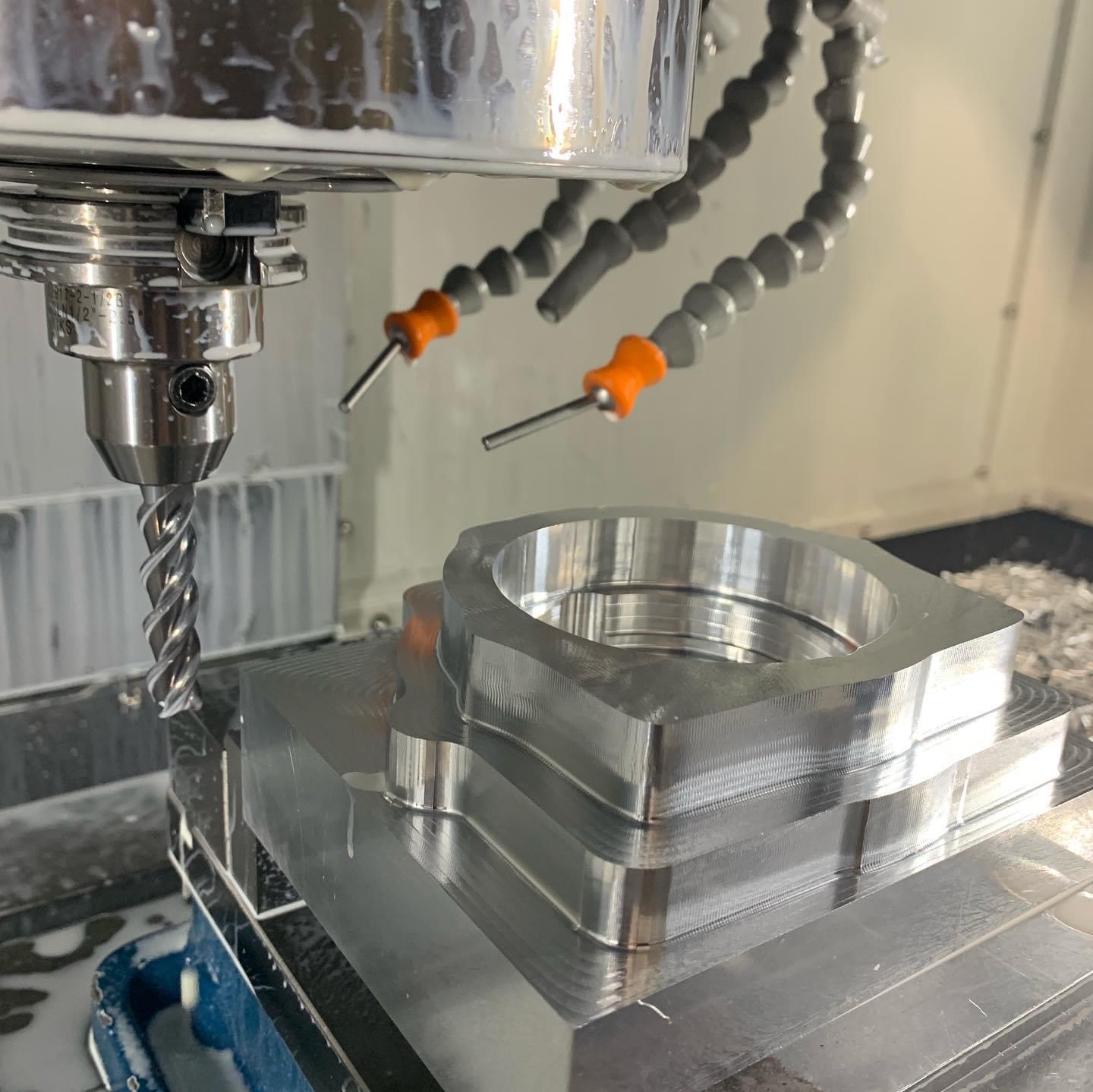
A CNC milling machine removes material by moving the cutter at an angle into the workpiece, using computer instructions to control the cutter’s movements. This technique provides extraordinary precision and repeatability.
As well as CNC milling, CNC turning is another popular CNC service for cutting workpieces from bar or block materials as they are rotated at high speed while they are engaged in a chuck. Instead of milling, CNC turning is typically used for creating rounded or tubular shapes.
CNC milling can be used for the rapid manufacture of either prototypes or end-use parts
How CNC milling works
To manufacture a CNC milling part, designers must first design the part with CAD (Computer-aided Design) software. The design is then converted into “G-Code” so the CNC mill can recognize it.
Workpieces are held in place on CNC mills by a worktable and work holding device. Depending on the style of the machine, the worktable may or may not move.
During CNC milling, the rapidly rotating cutting tool makes contact with the workpiece and removes material. The tool moves according to G-Code instructions so that the cuts are made in the right places until the part is complete. Some CNC mills use moving worktables to create a greater number of cutting angles.
Hard metals can be cut by CNC mills instead of CNC routers, which can penetrate softer materials but not harder ones. CNC mills differ from CNC lathes or turning centers, where the workpiece rotates rather than the cutting tool.
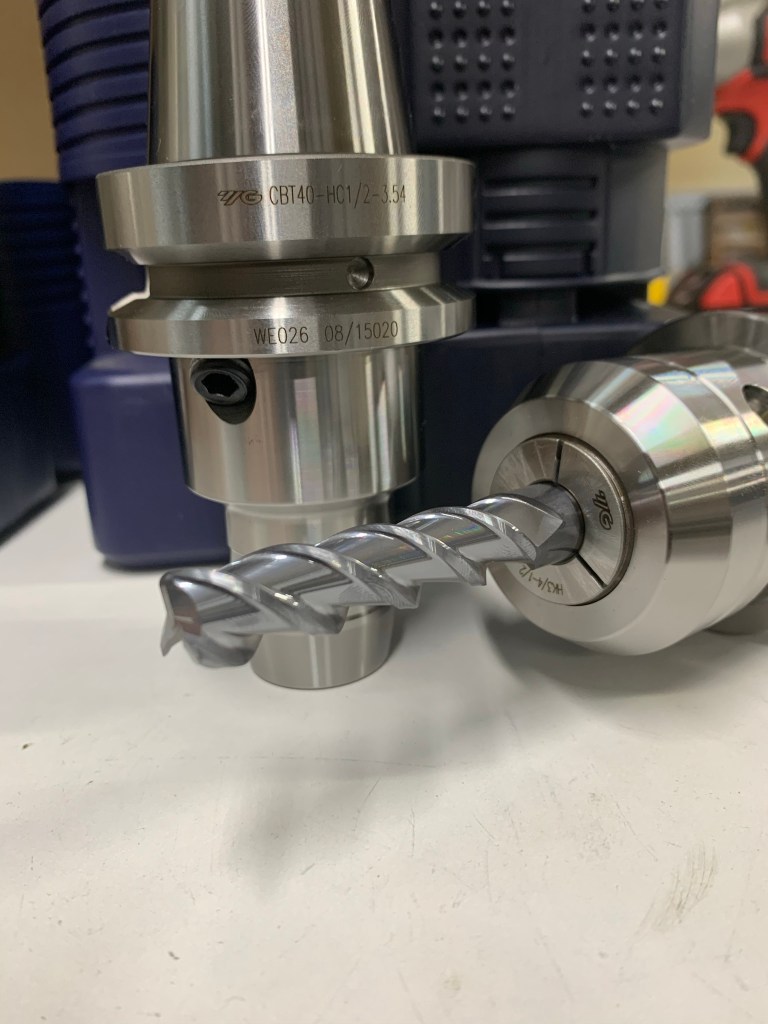
Cutting tools for CNC mills
CNC mills can be fitted with a variety of cutters and tools to enable different types of cutting, such as end mills, face mills, slab mills, fly cutters, ball cutters, hollow mills, roughing end mills, etc.
Contact us today for more information
regarding our free quote, CNC Machining, Prototype, CAD & CAM Programming, or Laser Marking Services.
Request a Quote
[cf7form cf7key=”request-a-quote”]
Contact Us
 RR CNC Services